


What happens if voters are allowed not only to choose who they vote for, but also where? In most democratic systems, electoral rules are designed in advance, so that on election day voters take them as given, no matter how unfair they might be: voters either vote for their preferred candidates or abstain. However, if political competition in a district is negligible or the number of seats apportioned to it does not reflect the size of its population, a vote cast elsewhere may count more. In such cases, it can hardly be said that all votes carry equal weight. The 2024 US presidential election illustrates how much the strategic importance of votes can vary across states: according to NPR, almost 70% of early campaign advertising spending went to just seven key states. Both campaigns concentrated their resources where they expected the election to be decided, treating votes elsewhere as less consequential. In theory, if voters were able to move freely across constituencies, their grassroots mobility could at least partially offset these inequalities.
In our study, we examine a rare setting in which voters can actually choose where they vote. Poland’s 2023 parliamentary election provides an example of such electoral mobility. Two institutional features made strategic re-registration both feasible and tempting: malapportionment – unequal representation arising from differences in the number of voters per seat across constituencies – and limited administrative barriers to temporarily changing one’s voting location. Together, these features allowed voters to redirect their ballots to constituencies where their votes carried more weight. We ask two questions: first, how extensive was this strategic mobility, and second, what effects did it have on local turnout and the final electoral results?
Why the 2023 election
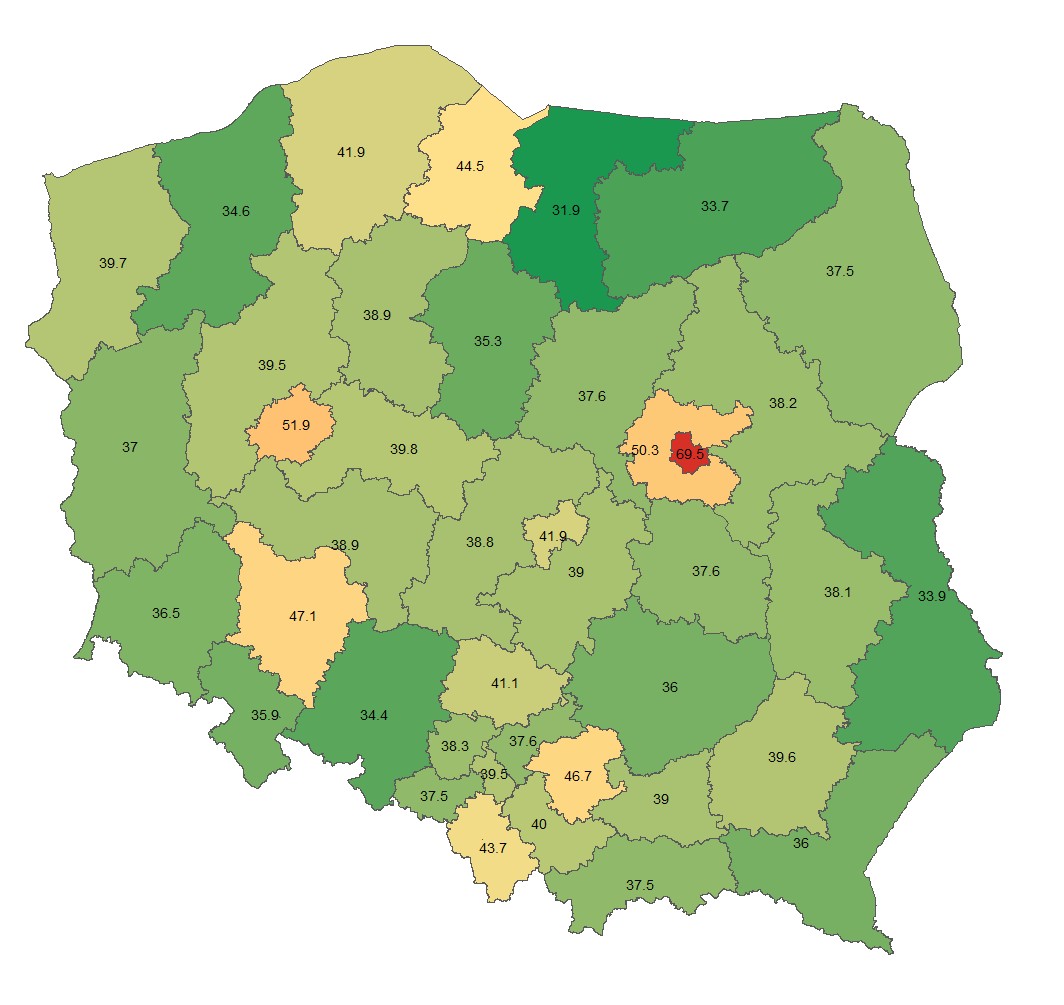
Although the Polish electoral system was designed to approximate equal representation across constituencies, this no longer seems to be the case. The number of seats apportioned to each constituency in elections to the Sejm (the parliament’s lower chamber) has not been updated since 2011. Meanwhile, substantial demographic changes have taken place, including internal migration from the countryside to urban areas. Turnout patterns also differ between districts: in big cities, voters tend to turn out more frequently. As a result, more voters compete for the same number of representatives in cities, systematically disadvantaging these districts. In 2019, almost 70,000 voters shared each seat in Warsaw, against only as much as 38,000 in some nearby districts (Figure 1). The main beneficiaries are rural constituencies, a natural stronghold of conservative parties.
In 2023, however, after eight years of democratic decline under the Law and Justice government, high electoral mobilisation on both sides of the political spectrum led liberal voters in cities to consider a previously overlooked opportunity: strategic re-registration. Polish electoral law allows for almost unrestricted changes of voting location, with no residency requirement or need to provide evidence to the authorities. By visiting a local municipal office or using a dedicated online system, voters can change their polling station or obtain a certificate that allows them to choose one even on election day. Originally, the system was designed to support voter turnout by enabling people travelling or living outside their municipality of registration to participate in the election. There are strong reasons to believe that, in the 2023 election, voters considered using this mechanism strategically for the first time. Online guides explaining where to vote to increase the chances of liberal parties started popping up across the Internet, while Google searches for the phrase “change of voting location” peaked at ten times their pre-2019 election level.
How we measure it
To answer our questions, we combine a theoretical model with an empirical analysis. The model describes how voters – deciding whether to move, vote at home, or abstain – weigh the cost of changing location against the extra weight of their vote. It also provides insights regarding the mobilisation patterns related to strategic mobility. The empirical part studies the resulting mobility using Polish
municipality-level data. Since we cannot track individuals or observe strategic mobility separately from other forms of mobility, the main empirical challenge is to disentangle these channels. We do so by relating the movement of voters to each municipality’s own voting power (the ratio of elected seats to voters) and to that of its closest neighbours.
Results and implications
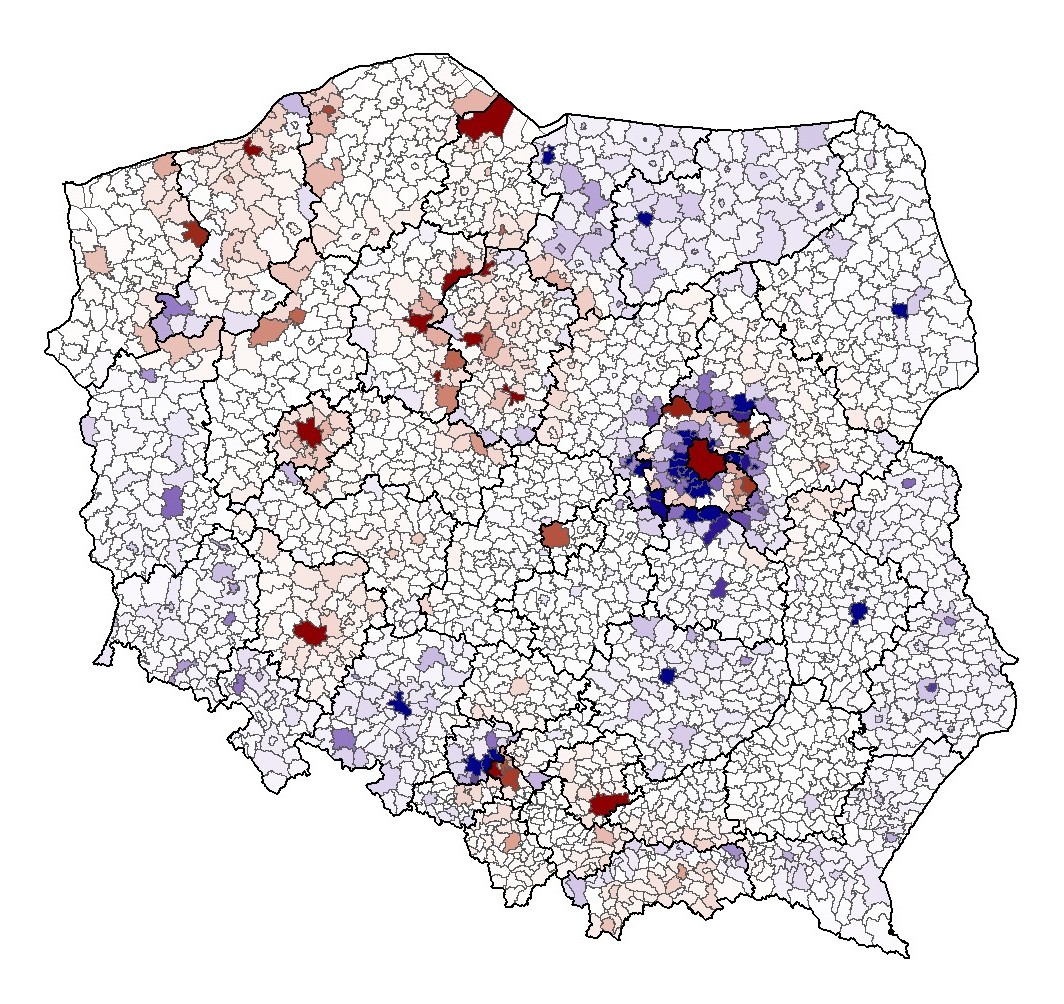
We find that municipalities close to constituency borders are more likely to experience higher inflows of voters when they have greater voting power. If, however, they are neighbours with other high-voting-power locations, this relationship weakens, as nearby destinations compete for the same voters. The clearest pattern is around Warsaw, where voters left the city for the surrounding municipalities (Figure 2). By comparing the model’s predictions with a scenario in which every vote carries the same weight, we estimate that around 33,000 voters moved strategically.
Next, we examine turnout in the municipalities that received these voters. We find higher mobilisation in destinations receiving larger inflows, even after accounting for the votes of the newcomers themselves. Finally, we consider several assumptions about who moved, including the possibility that only supporters of the liberal opposition did. Depending on how well these voters coordinated, they may have switched two seats in favour of the liberal parties (out of 460). At the same time, in each of the two previous parliamentary terms (2015–2019 and 2019–2023), the majority was secured by a
margin of no more than five seats. This suggests that the resulting coordination, though modest in scale, was remarkably efficient.
We should not expect a sudden equalisation of democratic representation across the globe. Pennsylvanians will still be more likely than New Yorkers to effectively influence the election of the US President. Similarly, the Spanish constituency of Soria might still elect more representatives per voter than Madrid. It is another question, of course, whether an unequal distribution of seats might sometimes serve as an intentional design meant to increase the bargaining power of otherwise disadvantaged regions. Our results show, however, that when given the opportunity, voters can be relatively effective in changing the electoral balance simply by moving between places. Despite imperfect information, some 33,000 voters, coordinating through online guides, may have been enough to shift two seats in the Sejm. When the allocation of seats falls out of date, voters may start correcting it themselves.
Authors: Michał Pawłowski and Michał Tulwin