


Economists have long worried that their seminar culture disadvantages women, not just as audience members, but also as speakers. A landmark study by Dupas and co-authors (2026) documents that female speakers at top US economics departments received 10% more questions than their male colleagues and were subjected to 44% more questions rated as negative in tone.
Does this pattern hold at European institutions? And how do researchers perceive what is happening in the room? We set out to answer these questions at the European University Institute (EUI), one of Europe's leading graduate economics departments.
What we did
Between January and June 2025, a team of seven PhD coders observed and systematically recorded 72 seminars, departmental talks, working groups, and job market presentations at the EUI Economics Department, covering 98.6% of all targeted events during that period. Coders noted the number of questions asked, who asked them (by gender and seniority), how long they lasted, and what tone they carried: neutral, supportive, patronising, demeaning, or hostile.
We then conducted a follow-up survey in September and October 2025 among junior researchers, PhD candidates in years 3 through 6 and postdoctoral fellows, asking them about their perceptions of the same seminar dynamics we had just measured. This allowed us to place perceptions directly alongside observed data for the same period.
Finding 1: Female speakers at the EUI receive broadly equal treatment
Unlike the US evidence, we find little sign of differential treatment of female speakers in the Department of Economics at the EUI. Female presenters receive statistically indistinguishable numbers of questions from their male counterparts, draw comparable audience sizes, and face questions of virtually identical tone. Only 2.4% of all questions observed were coded as having any negative tenor, and there was no meaningful gender gap in that share.
Finding 2: Male voices dominate the room
Even though female speakers are not treated worse, seminar discussions are overwhelmingly dominated by male voices. On average, women ask 3.5 questions per seminar; men ask 15.9. Even after accounting for the fact that women make up a smaller share of the audience, each male audience member asks more than twice as many questions as each female audience member.
Most strikingly, in the typical seminar, female audience members ask no questions at all. The most common number of questions asked by women in a single seminar is zero.
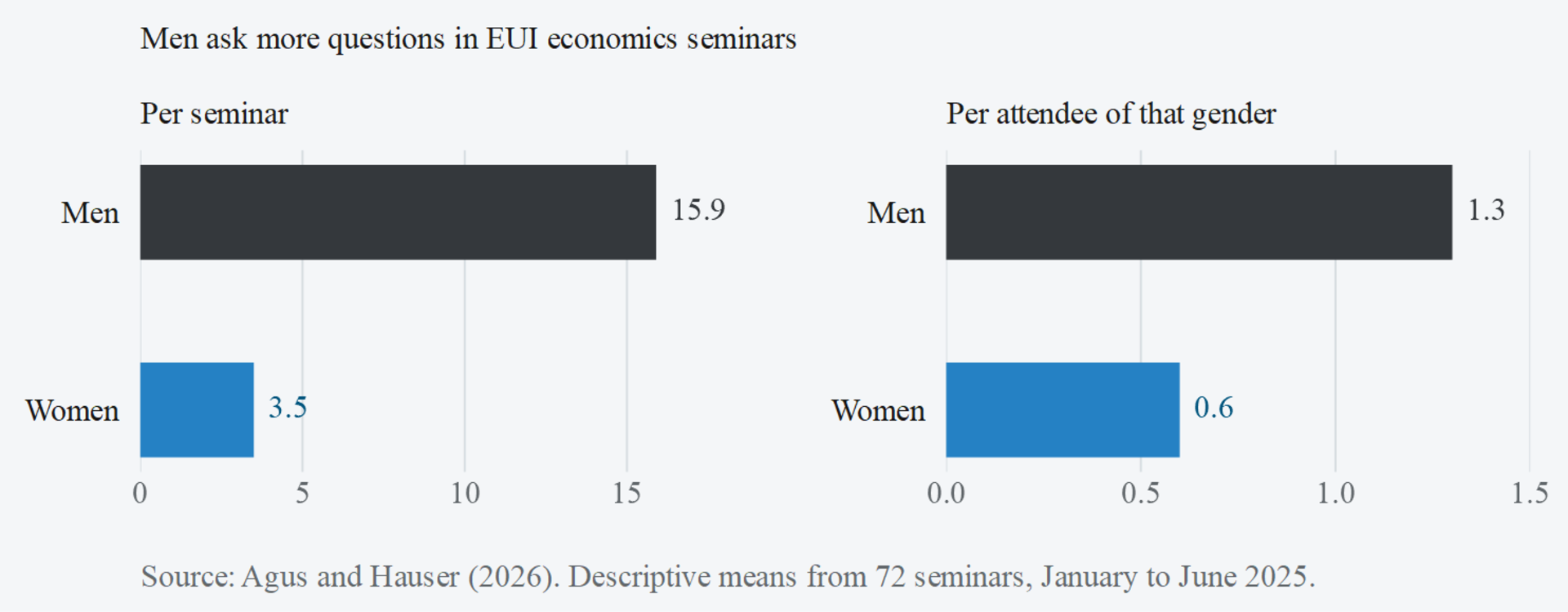
This gender gap in participation is not explained by the gender of the speaker: it persists regardless of whether a man or a woman is presenting. Something else is discouraging women from speaking up, and understanding what that is deserves attention.
Finding 3: Perceptions diverge sharply from reality
Our survey data reveal a paradox: junior researchers at the EUI perceive the seminar climate as substantially more hostile to women than the observed evidence supports.
Asked how often they observe negative questions in seminars, 61% of respondents said they often do. Our coders, observing the same seminars, found that just 2.4% of questions carried any negative tone. The gap is considerable.
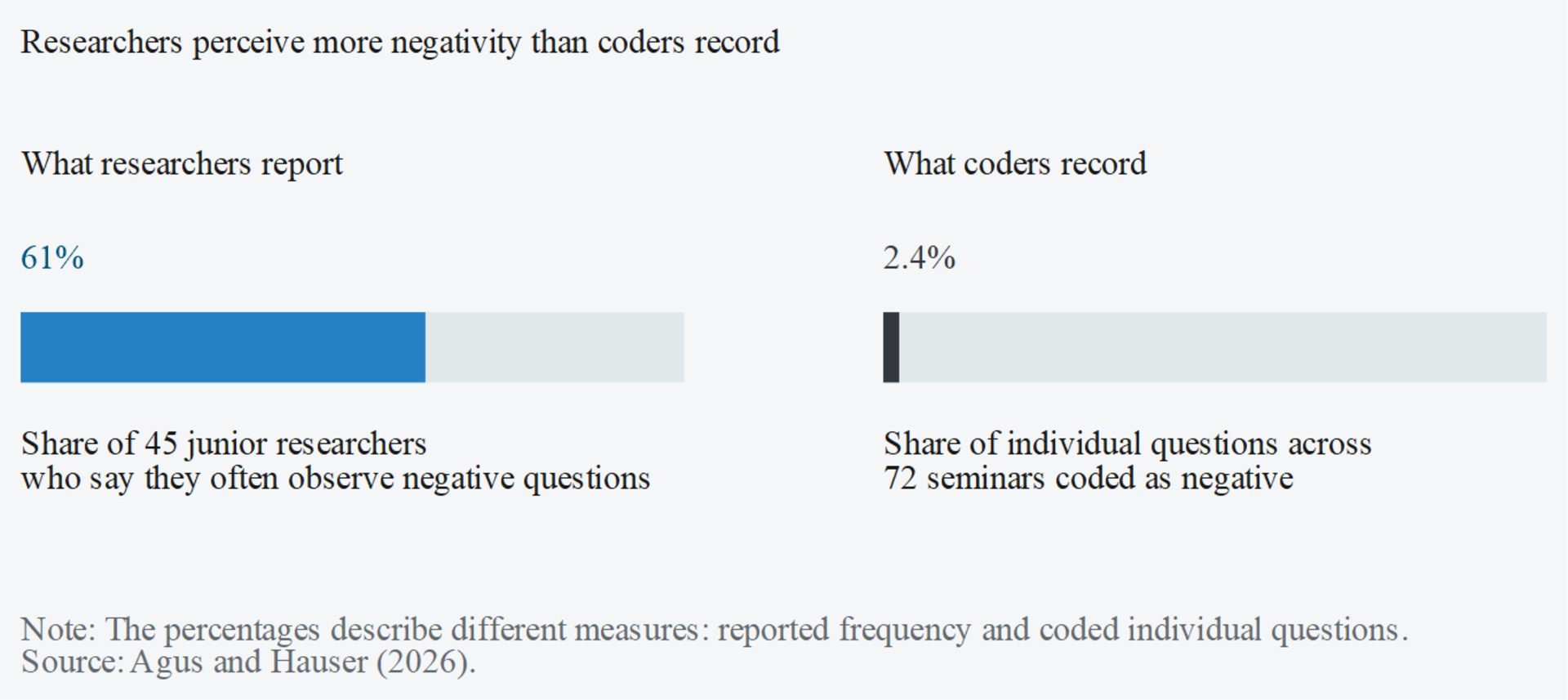
The gender gap in perceptions is especially striking. While 80% of female respondents believe that female speakers are more likely to receive patronising questions than male speakers, only 33% of male respondents share that view. Similar gaps emerge for demeaning and hostile questions. This pessimism among female researchers persists even though our data show no such differential treatment.
Respondents also underestimated the gender gap in audience participation: they guessed a 3:1 ratio of male to female questions, when the actual ratio is 4:1.
Why this matters
These findings carry three policy-relevant implications.
First, the good news: the hostile treatment of female speakers documented in Dupas et al. (2026) probably does not extend to the EUI. This suggests the culture of economics seminars is not fixed: it can be more equitable, and it appears to already be so in some institutional settings.
Second, the bad news: gender parity in speaking up remains a distant goal. Women who attend EUI seminars rarely ask questions. Even in a relatively equitable environment by the standards of the economics profession, the seminar floor belongs overwhelmingly to men. Future research and departmental initiatives should ask why: whether the cause lies in self-confidence gaps, social norms, informal hierarchies, or the way discussion is moderated.
Third, and perhaps most important: perceived hostility can be just as damaging as actual hostility. If women believe the seminar climate is hostile, even when it is not, those beliefs may still discourage them from raising their hand, presenting their work, or staying in the profession. Addressing gender disparities in economics requires not only fixing measurable behaviors but also shaping the climate of expectations and beliefs that surrounds those behaviors.
What can be done?
Our findings suggest that improving gender equity in economics seminars requires targeting several issues. Institutions should monitor and address differential treatment of speakers. But they should also focus on the participation gap: who is speaking among the audience, not just who is at the board. Future research should test which interventions and policies could help increase female participation in the discussions that are so characteristic of economics seminars and shape the direction of our discipline.
Equally important is addressing negative perceptions. While they seem overly pessimistic, our data do not allow us to determine their origin. Future research should try to understand whether a perceived negative seminar climate prevents women from participating in seminar discussions, and how perceptions can be shifted, for instance through an informational intervention or open discussion of seminar norms and practices.
Economics has made progress. But the seminar room, where reputations are built and careers are shaped, still has a long way to go.
Yusuf Agus is a researcher at the EUI Department of Economics.
Christina Sarah Hauser is an Assistant Professor of Economics at University College Dublin and an EUI alumna.