


Germany's unemployment insurance system has been repeatedly and contentiously reformed over the past two decades, from the Hartz overhaul of the early 2000s to the current government's replacement of the Bürgergeld with a stricter Neue Grundsicherung. Our forthcoming research offers a general equilibrium perspective: cuts to unemployment benefits do raise employment, but at a net welfare cost, driven by greater earnings risk and costlier job search.
Germany's unemployment insurance system has been a recurring battleground for economic and political debate since at least the early 2000s. The Hartz reforms, which tightened eligibility, strengthened job-search obligations and cut benefit levels and durations, marked one of the most far-reaching overhauls of a European welfare state in recent decades, and their effects on employment and inequality remain contested to this day. The debate has not gone away: the Merz government's recent decision to replace the Bürgergeld, Germany’s main welfare benefit, with a stricter Neue Grundsicherung has reignited the same fault lines, affecting around 5.5 million current recipients. Proponents argue that stronger obligations will bring more people into work; critics worry about the effects on the most vulnerable. Both sides, however, tend to focus on employment headcounts and fiscal savings, leaving a larger picture out of view.
In a forthcoming paper, we develop a general equilibrium model calibrated to the German economy that is well-placed to address this question. Our model combines a job ladder framework with a life-cycle economy. Employed workers search for better jobs, unemployed workers search for work, and households age, save for retirement, and face the possibility of unemployment. All three inputs of aggregate production, capital, employment, and labour efficiency, are jointly determined by the decisions of workers and firms in equilibrium. This makes our framework suited to tracing the full macroeconomic and welfare effects of benefit reforms.
What the data say: wealth and age shape job search
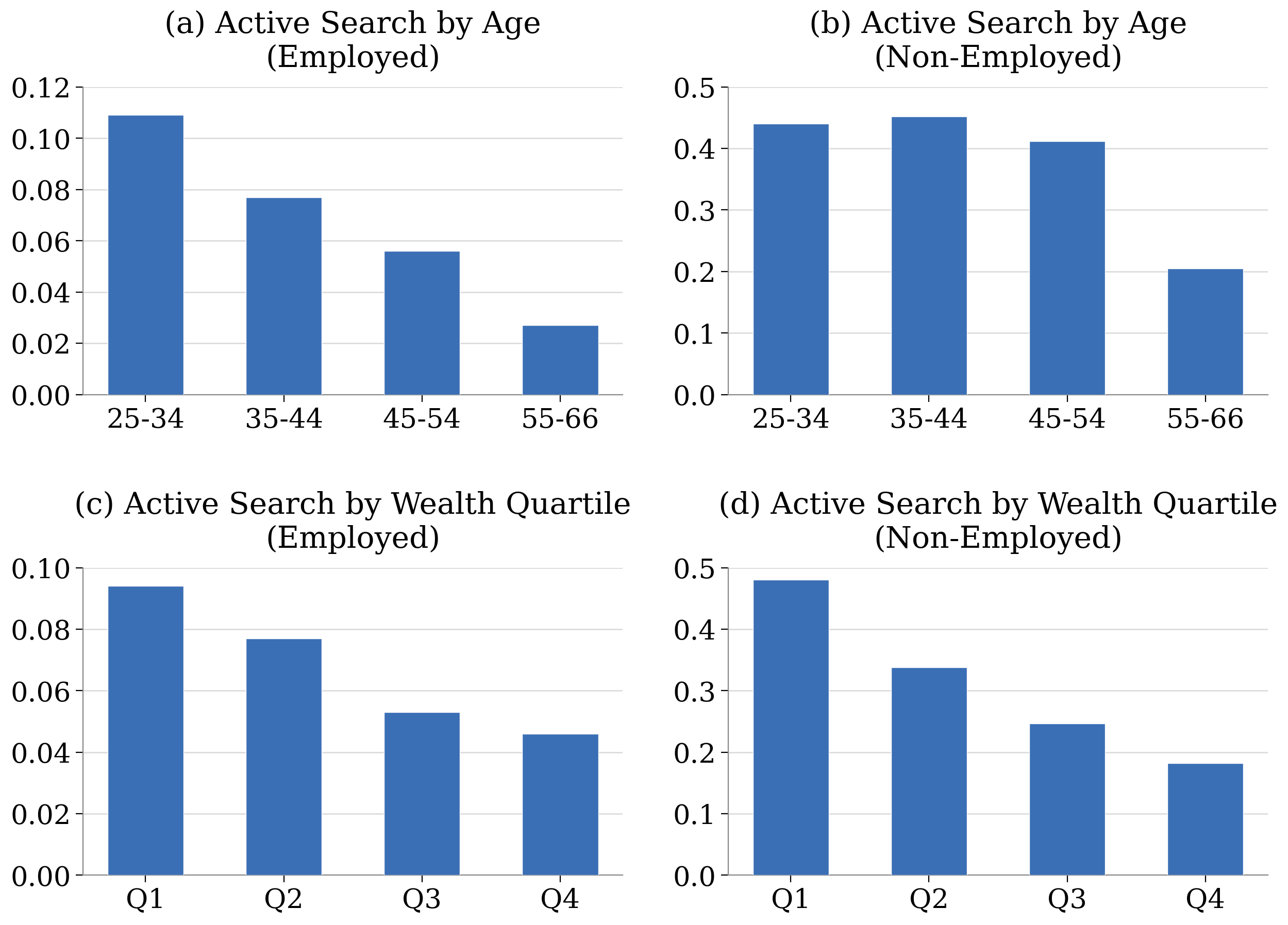
The model is disciplined by a clear pattern in German panel survey data: both off-the-job and on-the-job search decline with age and wealth (Figure 1). Job-finding rates also decline with age and wealth. Wealth gives workers more room to be selective; age shortens the horizon over which a better match pays off. These gradients anchor the calibration before we conduct the policy experiments.
Cutting benefits boosts employment, but reduces welfare
Our primary policy experiment reduces unemployment benefits by 10%, a change broadly in line with the direction of the German Hartz reforms. The aggregate effects are substantial: output rises by 2.9%, driven by a 2.7% increase in employment. With thinner public insurance, workers rely more on their own savings, raising the capital stock by 5.4%. Job creation expands, matching rates rise, and non-employed workers accept jobs they would previously have passed up. These are exactly the mechanisms that proponents of welfare tightening point to.
But when it comes to welfare, there is a less comfortable side to the story. Aggregate labour efficiency falls because workers accept more low-productivity jobs. Average wages decline by 0.4% and earnings inequality rises substantially. Despite higher output and higher employment, a newborn worker suffers a welfare loss equivalent to 1.32% of lifetime consumption. The dominant driver behind this is the higher cost of job search: when public insurance is weaker, workers must exert considerably more effort to find and maintain employment, and this effort is costly. Greater earnings uncertainty and volatility add to the welfare loss.
Who gains and who loses?
The effects differ by age and wealth. Younger and low-wealth workers, those with the most to gain from strong search incentives, respond most to the reform by ramping up their search effort; the largest job-finding gains are among younger workers. Yet it is older and wealthier households who bear the largest welfare losses, because they are most exposed to falling interest rates and rising labour income risk in general equilibrium.
A note on tax progressivity
Our paper also examines a second reform: reducing income tax progressivity from the German to the US level, keeping total tax revenues constant. This reform also affects the labour market, but through a different channel. A flatter tax schedule makes low-productivity matches less viable, so workers become more selective. Labour efficiency rises, but employment falls by 1.4% and output by 0.5%. The accompanying welfare loss is again driven by greater consumption risk, now emanating from less redistribution through the tax system combined with higher unemployment risk. Younger workers, who stay longer in unemployment and move less between jobs, suffer the most.
What policymakers should take away
The German reform debate tends to focus on aggregate employment and fiscal budgets. Our results suggest this framing is incomplete. Three messages stand out.
First, cutting unemployment benefits does raise employment, but comes at a welfare loss, particularly if earnings risks and search costs are not adequately weighed. Second, the distributional effects are large. The reform affects workers very differently depending on their age, income and wealth, dimensions that aggregate statistics mask. Third, general equilibrium effects are important and large. Capital, wages, job creation, and the interest rate all adjust in response to benefit cuts, in ways that alter the partial-equilibrium effects. Evidence from microeconometric studies of benefit changes, which our model replicates well, captures only part of the story.
Author: Leo Kaas, Etienne Lalé, and Nawid Siassi