
Author:
In German pension policy, the diagnosis has been clear for about thirty years. Yet some of the key treatments keep getting postponed. The report of the pension commission (Alterssicherungskommission) is a pleasant surprise. The experts state the demographic arithmetic plainly, propose binding rules, and take on two politically contested topics: the retirement age and a mandatory funded component within the statutory pension system. There is much to commend.
And yet one theme running through the report is worrying. Wherever the commission identifies a new task, it hands it to a public institution. A public fund is to invest the retirement savings. The German Pension Insurance (Deutsche Rentenversicherung) is to manage millions of individual capital accounts. The state is to organise annuitisation, pool longevity risk, and push costs down to ten basis points. That is considerable faith in the state's ability to build, within a few years, something that already exists in Germany: in occupational retirement provision, life insurers, and (occupational) pension funds.
The commission sets the right targets but chooses the wrong institutional vehicle. If we want to expand funded pensions quickly, broadly and cheaply, we should build on the private institutions we already have and give the state the role it plays best: that of setting the rules. And building this second layer must not raise the overall burden of contributions. Its costs should be met within a capped total contribution rate.
The overall burden matters
The commission warns that workers and employers must "not be unreasonably burdened further", because higher non-wage labour costs could push investment abroad. That is right, but the commission fails to draw the necessary conclusion. The mandatory two percentage points for the funded pension would be added on top, with no offsetting financing.
A better approach would pair the expansion of funded pensions with a lower contribution rate to the pay-as-you-go system. Policy should look at the total contribution rate, meaning the statutory pension contribution plus the funded savings share, and feed it into the pension indexation formula.
What matters to citizens is not the pension contribution alone but the sum of all levies. A duty to save in a funded scheme is implicitly a contribution, even if social insurance statistics do not record it as one. And that sum will rise: health and long-term care insurance face the same demographic pressure, while defence, infrastructure and climate adaptation expand the need for tax revenue. Raising the pension burden further to fund capital accounts uses up room for adjustment that is urgently needed elsewhere.
Funded and pay-as-you-go pensions draw on the same economy
The capacity to finance funded pensions depends on the efficiency of the economy, and above all on the labour market. The implicit return of a pay-as-you-go system is the growth of the wage bill: employment plus productivity. The return on a capital stock depends on the productivity of the capital employed, and hence on the same fundamentals. Both are returns from the same economy, but distributed differently and subject to different risks.
So labour market efficiency and an expansion of funded pensions go hand in hand. A longer working life widens the contribution base, lowers the required contribution rate, and so creates the room for building up funded savings. That is why the commission's recommendation to link the statutory retirement age to life expectancy is not a side note. It is the precondition for everything else.
Why a single state fund is risky
Funded arrangements can earn higher returns than the implicit return on pay-as-you-go pensions, and they give people without access to capital markets a share in them. That is the strongest social argument for funding: in Germany, the return on real capital has so far been largely a privilege of the wealthy.
The commission's proposal: an additional contribution of two percentage points, shared equally by employers and employees, is to flow into individual capital accounts, ideally from 2028. The money would be invested centrally in a "public, internationally competitive fund", with certified investment funds as an alternative. Costs should not exceed ten basis points, and payouts would come as a lifelong annuity together with the pay-as-you-go pension.
The model is Sweden, whose premium pension has achieved impressive results. But the German economy is about seven and a half times larger. A fully built-up German fund would be one of the largest single players in European capital markets. It would inevitably attract industrial and location-policy demands, and it would concentrate the operational and political risks of the entire second layer in one institution.
The commission itself calls for protecting the capital "against (including political) misappropriation". But protection by ordinary law is worth only as much as the next parliamentary majority. A capital stock that grows to around a trillion euros within two decades will attract covetous eyes.
In 2014, Poland transferred a large part of private pension fund assets into the state pay-as-you-go system. Hungary had done something similar before, and Argentina nationalised its funded system in 2008. This is predictable behaviour by states under fiscal pressure. Protection against such access, including for privately accumulated retirement savings, therefore belongs in the Basic Law, Germany's constitution, before the first contributions flow.
Practical questions, and institutions that already exist
The German Pension Insurance is excellent at managing earnings points. Running individual capital accounts for some 40 million workers over sixty years and more is a different business. Converting a fluctuating capital stock into a lifelong annuity requires decisions on actuarial assumptions, mortality tables, smoothing mechanisms and collective risk sharing, with an unavoidable trade-off between the level of the starting pension and the stability of payments later on.
Wouldn't it make more sense to build on established institutions here? Life insurers, Pensionskassen (insurance-based occupational pension institutions) and Pensionsfonds (occupational pension funds) have been doing exactly what is to be reinvented here for more than a century, supervised under the Insurance Supervision Act.
Keep expectations realistic
The expectation that the funded pension will raise benefit levels "noticeably" rests on methodologically sound simulations by the ZEW – Leibniz Centre for European Economic Research: an extra 150 euros of pension per month. The assumptions, however, are on the optimistic side. The point is not to talk down the funded pillar we need, but to set realistic expectations. If a substantial extra replacement rate is promised and far less is achieved because the returns don't materialise, the damage to public support for funded pensions will outweigh the benefit of the wealth built up.
A better route: occupational retirement provision
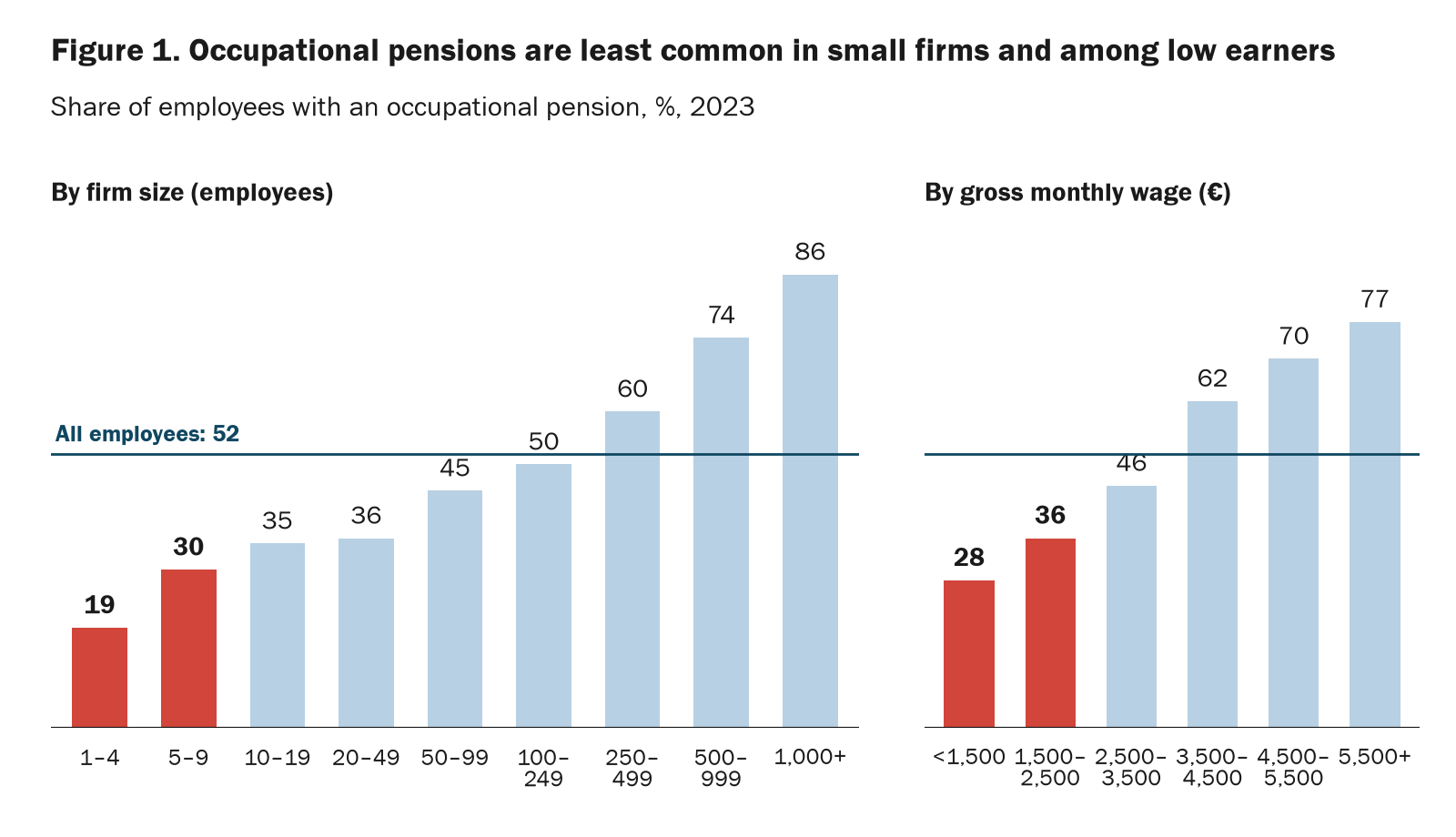
A better option than yet another state fund is already in the commission's report: expanding occupational retirement provision. These arrangements combine funding with collective risk sharing, bring in employers' financial contributions, and keep administrative costs down. Above all, they exist. The problem is low coverage. In firms with fewer than ten employees, coverage is about a quarter; among workers earning less than 2,500 euros gross a month, it is about a third (Figure 1). These are exactly the groups for whom the commission rightly demands access to capital markets.
This problem can be solved faster than by creating a new institution, for example through automatic enrolment with an opt-out. Employers would offer access to an occupational retirement savings arrangement and contribute their share, and employees could opt out. The United Kingdom dramatically increased coverage this way within a decade. The commission refers this option to a dialogue between the social partners. That is too little commitment for a well-documented tool.
Occupational retirement provision would also become more attractive if freed from mandatory guarantees. The commission opens up room for return-oriented investment in the statutory funded pension, but many occupational pension arrangements remain constrained by guarantee requirements that close off exactly this room. Such guarantees are not free. Savers pay for them with lower returns.
The state as rule-setter
Whether funded pensions serve their purpose depends less on who runs them than on how they are regulated. If the framework is right, provision can be left to existing providers. If it isn't, a state provider won't help either. It is even harder to control, because it belongs to the same principal who sets the rules. The state is strong as a rule-setter and weak as a producer. Why not use it only where it is strong?
Two elements are decisive for good regulation. First, a hard cost cap that applies equally to all providers. Anyone who stays under the cap may offer the product. A mandatory, standardised product without individual sales allows for large economies of scale. That is exactly how the commission justifies its ten basis points.
Second, clear rules on guarantees. In the savings phase there should be none. In the payout phase the reverse applies: binding rules on actuarial assumptions, mortality tables and smoothing, plus a duty to pay a lifelong minimum benefit that cannot be undercut. A mandatory market with annual inflows in the tens of billions of euros is attractive even at thin margins. So there will be providers.
If the state itself becomes the provider, it first needs an investment vehicle with constitutional protection against political access, an account administration, an annuitisation body, an independent investment committee, and a supervisor. Each of these institutions requires legislation and a political majority. Realistically, that takes closer to a decade than one or two years.
By contrast, existing products could be regulated within a year: the providers, the supervision and the account systems already exist. And time is the scarcest resource in pension policy. Every lost year of saving falls exactly in the period when the baby boomers retire. Losing even more time for an institution that has long existed in private form is not advisable.
Author: Alexander Ludwig, Professor for Public Macroeconomics European University Institute